Background Subtraction
The analysis.background module implements three physically motivated background
models for removing inelastic scattering contributions from XPS spectra.
Mathematical Models
Shirley Background
The Shirley background models the inelastic background as proportional to the integrated peak intensity. It is computed iteratively:
where \(k\) is a scaling factor determined by the condition \(B(E_{\text{low}}) = I(E_{\text{low}})\). Convergence is reached when \(\max(|B_{n+1} - B_n|) < 10^{-5}\).
from xps_analyzer.analysis import shirley_background

result = shirley_background(spectrum, inplace=False)
Tougaard Background
The Tougaard model uses a universal cross-section parameterization:
Four variants are available, calibrated for different material classes:
| Variant | B (eV²) | C (eV²) | D (eV²) |
|---|---|---|---|
| Universal | 2866 | 1643 | 0 |
| Polymer | 1122 | 1638 | 0 |
| Sc元素 | 500 | 1500 | 500 |
| Custom | Configurable | Configurable | Configurable |
from xps_analyzer.analysis import tougaard_background

result = tougaard_background(spectrum, variant="universal", inplace=False)
Linear Background
A simple linear interpolation between two endpoints:
from xps_analyzer.analysis import linear_background

result = linear_background(spectrum, inplace=False)
Fallback Strategy
The background_with_fallback function implements an automatic cascade:
- Try Shirley background
- If Shirley fails to converge (unusual lineshape), fall back to Tougaard
- If Tougaard produces unphysical results, fall back to Linear
from xps_analyzer.analysis import background_with_fallback

result = background_with_fallback(spectrum, inplace=False)
Visual Comparison
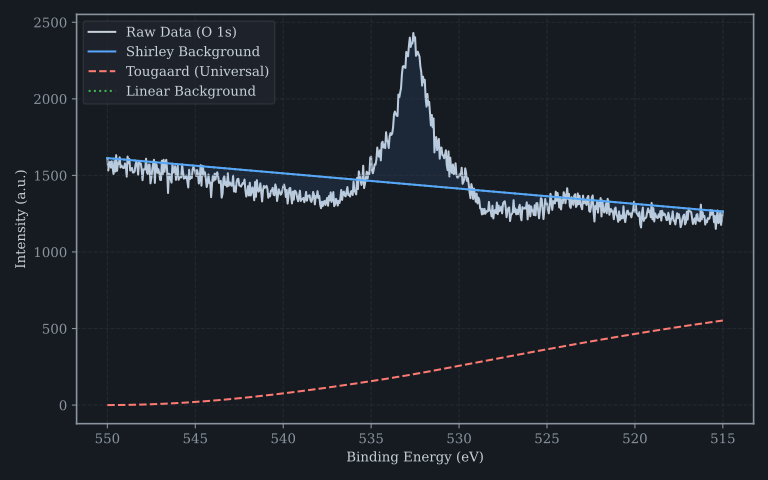 Comparison of Shirley, Tougaard, and Linear background models applied to an O 1s spectrum.