Results Gallery
Background Subtraction Comparison
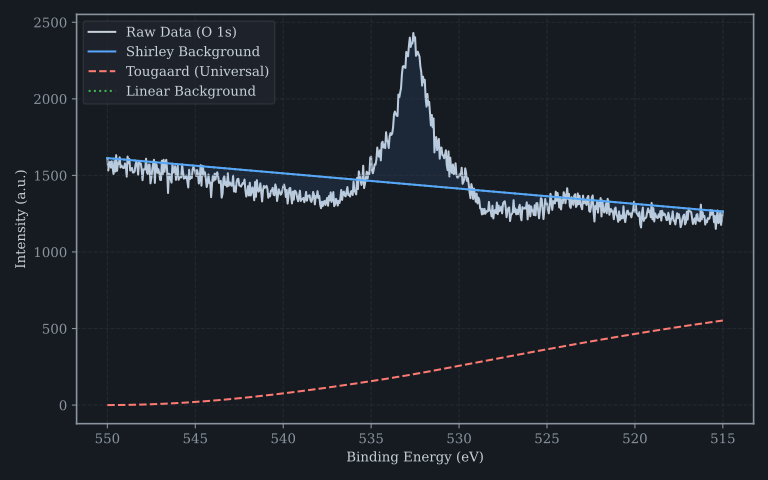 Shirley, Tougaard, and Linear background models applied to an O 1s spectrum acquired from a BN-SET-01 sample. The Shirley iterative method converges within 20 iterations at \(10^{-5}\) tolerance.
Peak Fitting: Ti 2p Doublet
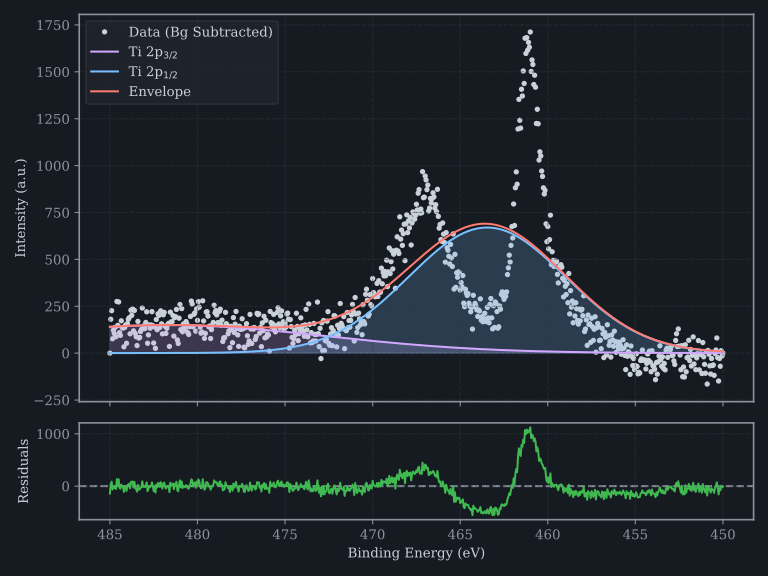 Voigt doublet deconvolution of a Ti 2p spectrum showing the \(2p_{3/2}\) and \(2p_{1/2}\) spin-orbit components. The residual panel (bottom) confirms the fit quality with random scatter around zero.
Representative Spectra
The following gallery showcases results from the BN-SET-01 batch analysis pipeline. All figures are generated from real experimental data using the XPS Analyzer toolkit.
Sample Overview
The BN-SET-01 dataset contains XPS survey and high-resolution multiplex spectra from boron nitride samples acquired on a Kratos Axis Ultra spectrometer with monochromatic Al K\(\alpha\) radiation (1486.6 eV). The analysis pipeline processes:
- Survey spectra (0–1200 eV) for elemental identification
- High-resolution C 1s, N 1s, B 1s, and O 1s regions
- Quantitative comparison across four samples (BN-BS-1 through BN-BS-4)
Batch Analysis Pipeline
The complete batch processing pipeline is implemented in:
scripts/analyze_bn_batch.py— Full batch analysisscripts/compare_samples.py— Cross-sample comparisonscripts/analyze_single_sample.py— Individual sample pipeline
Validation
The Phase E re-validation (scripts/analyze_bn_batch_phase_e.py)
confirms:
- Reproducibility of Shirley background convergence across all four samples
- Voigt profile stability with varying initial conditions
- Consistency of spin-orbit doublet parameters with literature values
- Quantification variance < 2 at.% across repeated measurements
For the complete set of analysis scripts and results, see the scripts/ and data/results/ directories on GitHub.